
How Long Does SEO Take to Show Results (and How Can You Speed It Up)?

Only 5.7% of newly published pages rank in the top 10 search results within their first year. For those high-performing pages, reaching the front page typically takes anywhere from 60 to 180 days, depending on keyword difficulty and existing domain strength.
Organic search is an enterprise asset that builds compound interest over time rather than an instant switch. Understanding the underlying timeline of search engine optimization helps companies allocate resources effectively, set realistic growth benchmarks, and avoid prematurely abandoning strategies that are on the verge of driving revenue.
Here is a practical look at how long SEO takes, what influences your timeline, and how to accelerate your results safely.
Typical SEO timeline: month 1–12 breakdown
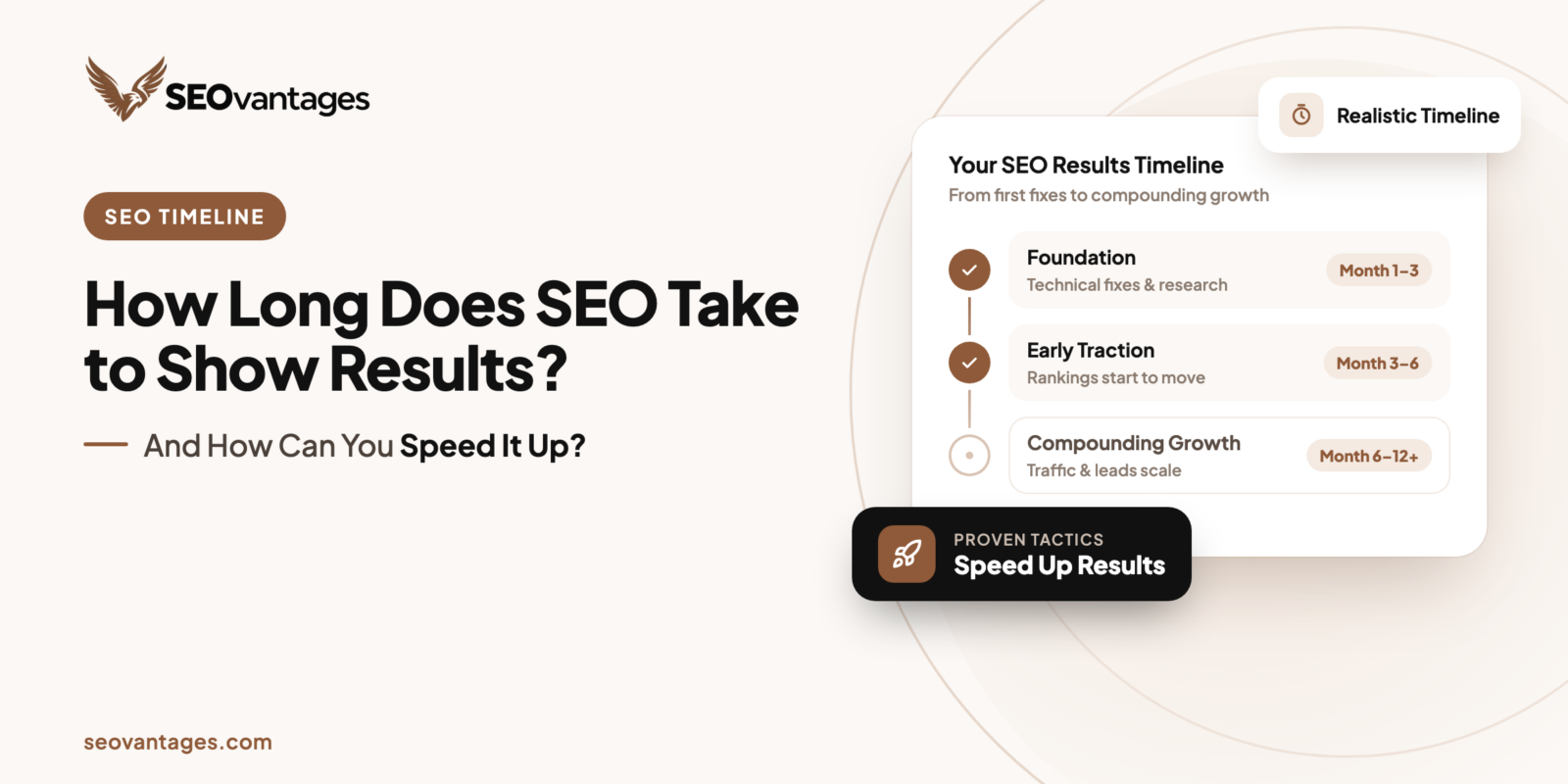
SEO campaigns follow a distinct ramp-up period. While every website begins from a different starting line, most B2B and commercial websites follow a predictable 12-month progression.
Months 1–3: Technical Foundation and Discovery
The initial quarter focuses on discovery, fixing structural issues, and establishing baseline data.
- Technical Audits: Resolving crawl errors, site speed bottlenecks, duplicate content, and indexation issues.
- On-Page Optimization: Mapping primary keywords to target pages, rewriting titles, meta descriptions, and header tags.
- Content Planning: Conducting competitor gap analysis and establishing a content publishing workflow.
During this stage, ranking changes are minimal, but search engine crawlers begin re-indexing your updated pages.
Months 4–6: Indexation and Early Traction
During the second quarter, search engines process structural updates and index newly published content.
- Impression Growth: Google Search Console will show a noticeable spike in impressions before top-line traffic increases significantly.
- Long-Tail Rankings: Pages begin appearing on pages 2 through 5 for lower-competition long-tail keywords.
- Initial Organic Traffic: Early visitors start arriving via specific, low-volume search terms.
Months 7–9: Measurable Traffic Gains
By late Q3, Google’s algorithms have accumulated sufficient user interaction signals to evaluate your content’s quality and relevance.
- Page 1 Positions: Target keywords move from back pages into positions 4 through 10.
- Traffic Acceleration: Non-branded organic traffic sees steady month-over-month increases.
- Lead Generation: Initial conversion activity begins as high-intent pages start ranking higher.
Months 10–12+: Compound Growth and Authority
By the end of year one, ongoing optimization produces compounding return on investment.
- Top 3 Rankings: High-intent primary keywords begin contesting top positions.
- Domain Authority: Natural backlink acquisition accelerates due to higher search visibility.
- Predictable Pipeline: Organic search becomes a stable channel for qualified leads and sales calls.
| Campaign Phase | Key Focus Areas | Expected Milestones | Primary Metrics |
|---|---|---|---|
| Months 1–3 | Audits, technical fixes, keyword mapping | Clean indexation, crawl error resolution | Site health score, indexed pages |
| Months 4–6 | Content creation, internal linking | Impression growth, long-tail positions | Google Search Console impressions |
| Months 7–9 | Authority building, on-page optimization | Page 1 rankings for secondary keywords | Organic traffic, conversion count |
| Months 10–12+ | Scaling content, conversion optimization | Top 3 positions for competitive terms | Revenue, customer acquisition cost |
Factors that speed up or slow down results
The search engine optimization timeline varies significantly between sites. Several operational and strategic variables dictate how fast your organic visibility grows.
Factors That Speed Up SEO Results
- Existing Site History: Websites with established trust and clean history index new content much faster than newly registered domains.
- Technical Health: Clean site architecture allows search engine bots to crawl and index updates efficiently.
- Consistent Publishing: Releasing thoroughly researched, original content regularly prompts search engines to crawl your site more frequently.
- Strong In-house Execution: Having web developers ready to implement technical recommendations prevents months of unnecessary delay.
Factors That Delay SEO Progress
- Excessive Competition: Targeting broad, high-volume terms against established industry publications lengthens the time to rank on Google.
- Algorithmic Penalties: Resolving manual actions or recovering from severe algorithmic updates delays overall progress.
- Slow Approval Workflows: Content sitting in review queues for weeks stifles momentum.
- Thin or Duplicate Content: Publishing low-quality pages without original insights delays indexation and suppresses site-wide quality scores.
Domain age, competition & authority
Google handles established domains differently than new ones. Understanding these differences helps frame realistic performance expectations.
The New Domain Sandbox Effect
New websites face an inherent trust deficit. Google places new domains in a functional ramp-up period to verify that the site is legitimate, stable, and safe for users.
- Indexation Delays: New pages may sit in Google’s indexing queue for weeks before appearing in search results.
- Conservative Rankings: Early rankings often fluctuate wildly as algorithms test user engagement metrics.
- Focus Requirement: Young domains must prioritize specific, long-tail search terms before attempting to compete for high-volume head terms.
Domain Authority and Historical Context
Established sites with clean link profiles enjoy a significant speed advantage. When an authoritative site publishes a new piece of content, search crawlers discover and evaluate it almost immediately.
- Backlink Profiles: Sites with earned editorial links pass page-level equity across internal links to newly published content.
- Topical Authority: Search engines evaluate how thoroughly a website covers a specific subject area over time. Broad, detailed coverage signals expertise, allowing new articles in that topic cluster to rank significantly faster.
Quick wins in the first 90 days
While long-term competitive keywords take time to reach page one, early strategic updates can deliver noticeable traffic improvements within the first 90 days.
1. Optimize Striking-Distance Keywords
Pages ranking on page two of Google (positions 11 through 20) are already trusted by search engine algorithms. Small updates can nudge these pages onto page one.
- Identify keywords in positions 11–20 using Google Search Console or SEO software.
- Update header tags to better match user search intent.
- Expand thin sections with specific details, expert quotes, or relevant data points.
2. Fix Technical Blockers and Broken Links
Technical fixes clear pathways for search engine crawlers, allowing equity to flow through your site correctly.
- Redirect broken links (404 errors) passing authority from external websites.
- Correct cannibalization issues where multiple pages compete for the same search term.
- Add internal links from high-authority pages to newer, underperforming content.
3. Claim and Optimize Google Business Profile
For businesses serving specific geographic regions, local visibility updates deliver faster returns than broader organic optimizations.
- Complete every field in your Google Business Profile.
- Add detailed product and service descriptions.
- Implement structured local business schema markup across your website.
When to expect leads, not just rankings
A common frustration among business leaders is seeing keyword rankings improve without an immediate increase in inbound inquiries or sales. Organic rankings reflect visibility, whereas lead generation requires converting that visibility into pipeline value.
The Conversion Gap
Ranking for informational search terms drives visitor traffic, but those visitors may not be ready to buy. Lead generation depends directly on user intent and on-page conversion design.
- Top-of-Funnel Intent: Informational search terms (“what is SEO”) build initial awareness but yield lower immediate conversion rates.
- Bottom-of-Funnel Intent: Commercial search terms (“B2B SEO agency pricing”) drive smaller overall traffic volumes but convert at significantly higher rates.
Aligning Traffic with Commercial Outcomes
To ensure ranking improvements translate into pipeline value, businesses must bridge the gap between content and conversion.
- Match Intent: Direct commercial search traffic to clear landing pages featuring clear value propositions, transparent pricing details, and easy scheduling options.
- Add Contextual Calls-to-Action: Embed relevant resources, case studies, or diagnostic tools within high-traffic informational articles.
- Optimize Page Experience: Ensure fast loading speeds, clean mobile navigation, and clear contact forms so potential clients can reach your team easily.
Frequently Asked Questions
Can SEO work in 1 month?
While complete SEO success takes longer, technical updates and page-two keyword optimizations can yield early impressions within 30 days. However, driving consistent traffic and sales leads generally requires 4 to 6 months of execution.
Why is my SEO not working after 6 months?
SEO progress often stalls due to unaddressed technical issues, low domain authority, intense competition, or targeting keywords that lack search volume. Poor content quality and slow implementation workflows can also delay organic results.
How do I know SEO is progressing?
Track early indicators before expecting direct conversion growth. Look for increases in total search impressions, expanding keyword visibility, improved position rankings for target terms, and steady growth in non-branded organic traffic.
Is PPC faster than SEO?
Yes, Pay-Per-Click (PPC) advertising delivers immediate traffic once ad campaigns launch. However, PPC traffic stops as soon as ad spend ends, whereas SEO builds lasting domain equity that generates organic traffic over time.