
How to Choose an SEO Agency: 15 Questions to Ask Before You Sign

According to BrightLocal’s Local Consumer Review Survey, over 98% of consumers use the internet to find local businesses, making search engine visibility a core driver of revenue.
Hiring an SEO company is a major financial commitment, but selecting the wrong partner costs far more than just your monthly retainer. It can result in wasted months, lost search rankings, and severe Google manual penalties that take years to recover from.
Knowing how to choose an seo agency requires asking tough, highly targeted technical questions before signing any contract. Here is a practical, step-by-step framework to evaluate candidates and protect your organic growth.
Why agency choice matters
Selecting an SEO partner directly impacts your digital footprint, technical infrastructure, and brand reputation. Organic search is rarely a fast-fix channel; it requires consistent technical site hygiene, high-quality content creation, and authoritative link acquisition over six to twelve months.
Choosing the right agency leads to compounding organic traffic, lower customer acquisition costs, and sustainable revenue growth. Conversely, choosing an unqualified provider risks:
- Severe Search Penalties: Unethical practices like purchasing low-quality link blasts can trigger Google Algorithmic or Manual Actions, wiping out your organic traffic overnight.
- Wasted Marketing Budget: Paying monthly retainers without clear KPIs leads to lost capital that could have funded higher-yielding channels.
- Technical Site Damage: Inexperienced agencies making unvetted changes to your site architecture or robots.txt files can de-index key product pages.
15 questions to ask (with good vs bad answers)
To help you vet potential partners, use this seo agency checklist during your consultation calls. Evaluating their answers against industry standards will help you identify competent professionals.
Strategy and Vetting Questions
1. How do you tailor your SEO strategy to our industry?
Good Answer: “We analyze your business model, customer search intent, and competitors to build a custom roadmap targeting high-intent commercial keywords.”
Bad Answer: “We use our standard 30-day package that works for every client regardless of niche.”
2. What specific SEO metrics do you measure to define success?
Good Answer: “We track organic conversions, qualified leads, organic revenue, search visibility, and keyword group rankings.”
Bad Answer: “We focus strictly on total traffic volume and total backlinks created.”
3. How do you perform keyword research and prioritize opportunities?
Good Answer: “We combine search volume with user intent analysis, keyword difficulty, and business priority to target conversion-ready topics.”
Bad Answer: “We target the highest-volume search terms available in your industry.”
4. How long until we see measurable results?
Good Answer: “Initial technical fixes show impact in 60–90 days, but compounding revenue growth typically takes 6 to 12 months.”
Bad Answer: “We can get your site to page one of Google within two to three weeks.”
5. How do you approach mobile optimization and page speed?
Good Answer: “We audit your Core Web Vitals, mobile responsiveness, and server performance, coordinating with developers to fix latency.”
Bad Answer: “Mobile optimization isn’t necessary unless you run an e-commerce store.”
Technical and Execution Questions
6. What is your strategy for off-page SEO and link building?
Good Answer: “We secure contextual backlinks through digital PR, guest editorial outreach, and unlinked brand mention reclamation.”
Bad Answer: “We submit your website to thousands of directories and blog comment sections automatically.”
7. How do you ensure our content complies with Google guidelines?
Good Answer: “We build content that fulfills Google’s E-E-A-T (Experience, Expertise, Authoritativeness, and Trustworthiness) criteria.”
Bad Answer: “We spin existing top-ranking articles using automated AI tools to output dozens of pages a day.”
8. How do you handle technical site audits?
Good Answer: “We crawl your site to identify crawl errors, duplicate content, broken links, canonicalization issues, and schema markup errors.”
Bad Answer: “We run a free automated tool once a year and send you the exported PDF.”
9. What tools do you use for research and performance tracking?
Good Answer: “We use industry standards like Google Search Console, Google Analytics 4, Ahrefs, Semrush, and Screaming Frog.”
Bad Answer: “We have a proprietary secret software that outperforms all standard SEO tools.”
10. Will you need access to our site, and how will changes be implemented?
Good Answer: “We require site access and will provide detailed staging recommendations or implement changes directly with your team’s approval.”
Bad Answer: “We do not need site access; all SEO takes place externally.”
Communication, Process, and Governance Questions
11. Who will handle our account directly?
Good Answer: “You will have a dedicated account manager and direct access to senior technical specialists during strategy calls.”
Bad Answer: “Our sales rep will handle your account, or we assign tasks dynamically to an unlisted pooled team.”
12. How often will we receive reports, and what will they cover?
Good Answer: “We provide monthly written reports detailing ranking movements, organic traffic shifts, conversion metrics, and completed tasks.”
Bad Answer: “We send automated monthly ranking updates without explanation or commentary.”
13. How do you stay updated on Google algorithm updates?
Good Answer: “Our team tracks Google Search Central updates, tests strategies in-house, and participates in industry forums.”
Bad Answer: “Google updates do not affect our methods because our formula never changes.”
14. What happens if our organic traffic drops significantly?
Good Answer: “We conduct an immediate audit to isolate the root cause, review Google Search Console alerts, and deploy a recovery plan.”
Bad Answer: “Fluctuations happen randomly; you just have to wait for Google to fix it automatically.”
15. What are your standard contract terms and cancellation policies?
Good Answer: “We offer 6-month initial terms or flexible 30-day notice periods after an initial onboarding phase, with full asset ownership.”
Bad Answer: “We require a binding 24-month contract with mandatory cancellation penalties and proprietary asset retention.”
Red flags: guarantees, PBNs, vague reporting
When hiring an seo company, learning to recognize seo company red flags early will save your business significant resources. Walk away immediately if a prospective agency exhibits any of these behaviors:
- Guaranteed #1 Rankings: Google’s official Webmaster Guidelines explicitly state, “No one can guarantee a #1 ranking on Google.” Search algorithms consider hundreds of factors, rendering absolute ranking guarantees impossible.
- Private Blog Networks (PBNs): PBNs are networks of expired domains built solely to link to client websites. Google treats PBNs as link schemes, which can lead to algorithmic de-indexing.
- Vague or Vanity Reporting: Agencies that report only on vanity metrics like “total impressions” or raw keyword counts while ignoring organic conversions, leads, and revenue are likely hiding a lack of real performance.
- Refusal to Disclose Tactics: Legitimate agencies maintain full transparency regarding their link sources, content creation workflows, and technical modifications.
Contract terms & ownership of assets
A major point of friction between businesses and SEO agencies involves legal ownership and contract terms. Always review contract clauses carefully before signing.
Ensure your agreement explicitly guarantees that all metadata, technical optimizations, strategic roadmaps, and published assets remain your property upon contract termination.
Evaluating case studies
When finding the best seo agency, do not accept case studies at face value. Look for proof of execution and real business impact rather than isolated ranking numbers.
- Verify the Metrics: Ensure the case study measures bottom-line business metrics like revenue or lead increases, not just overall impressions.
- Look for Similar Industries: Ask for examples within your niche or industries with similar buying cycles and technical complexities.
- Request Live References: Speak directly to current or former clients to evaluate the agency’s responsiveness, communication style, and reporting accuracy.
- Examine Strategy Details: Confirm that the case study outlines the technical tactics used to resolve specific problems rather than offering vague summaries.
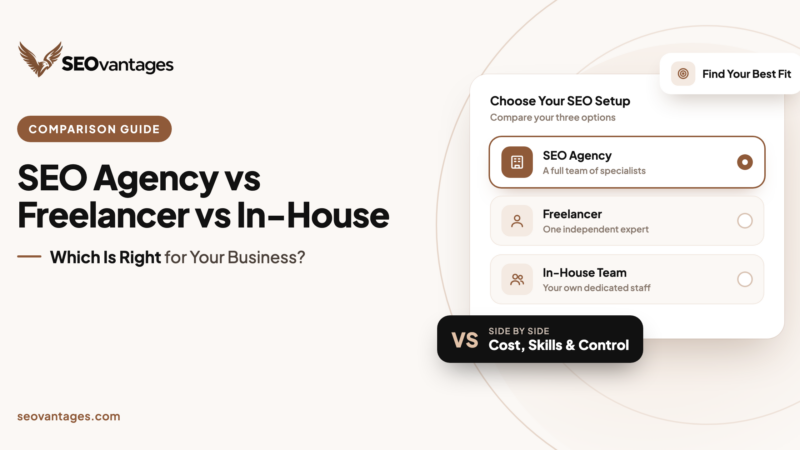
Agency vs freelancer vs in-house
Determining how to choose an seo agency also requires comparing agencies against alternative hiring models:
1. SEO Agency
- Pros: Full team of specialists (technical SEOs, copywriters, link builders, data analysts); access to enterprise tools.
- Cons: Higher monthly retainers; shared resource allocation across multiple clients.
2. Freelancer
- Pros: Lower cost; direct communication with the person executing the work.
- Cons: Limited bandwidth; depth of knowledge often constrained to specific areas (e.g., content over technical SEO).
3. In-House Specialist
- Pros: 100% dedicated to your company; immediate integration with internal teams.
- Cons: High cost (salary, benefits, software tools); single point of failure if the employee leaves.
Frequently Asked Questions
Q: What should I look for in an SEO company?
Look for transparent reporting, technical competence, and a focus on revenue metrics over vanity numbers. Choose an agency that audits your site before sending a proposal, presents clear case studies, and adheres to Google Search Essentials without promising guaranteed rankings.
Q: Should an SEO agency guarantee rankings?
No. Google explicitly warns against agencies that guarantee top rankings. Search algorithms change constantly, and competitors actively adjust their strategies. Ethical agencies guarantee transparent processes, clear deliverables, and adherence to industry best practices instead of specific position placements.
Q: How do I know if my SEO agency is doing a good job?
Evaluate performance by tracking organic traffic growth, keyword ranking trends for key pages, and organic conversions. Look for clear monthly reporting, proactive communication, consistent execution of planned tasks, and a positive return on investment.
Q: How long should an SEO contract be?
Initial SEO contracts typically run 3 to 6 months to account for the time required to perform technical audits and implement changes. After the initial agreement, contracts should ideally transition to month-to-month terms with a standard 30-day cancellation policy.
Finding the Right SEO Partner
Selecting an SEO agency requires balancing technical competence, transparent communication, and business alignment. By asking targeted questions, checking references, and watching for industry red flags, you can establish a partnership that builds durable search visibility.
If you are looking to audit your digital presence or need transparent guidance on scalable organic growth, explore our services at SEOvantages to build a search strategy tailored to your revenue goals.