

SEO Agency vs Freelancer vs In-House: Which Is Right for Your Business?

According to Glassdoor salary data, hiring a full-time, experienced SEO Manager in the United States costs an average base salary of around $80,000 to $100,000 per year. When you add employee benefits, payroll taxes, software subscriptions, and recruitment costs, the total financial outlay easily passes $120,000 annually. For many growing organizations, committing that level of capital to a single headcount is a major financial risk, especially when specialized technical or link-building skills are still needed.
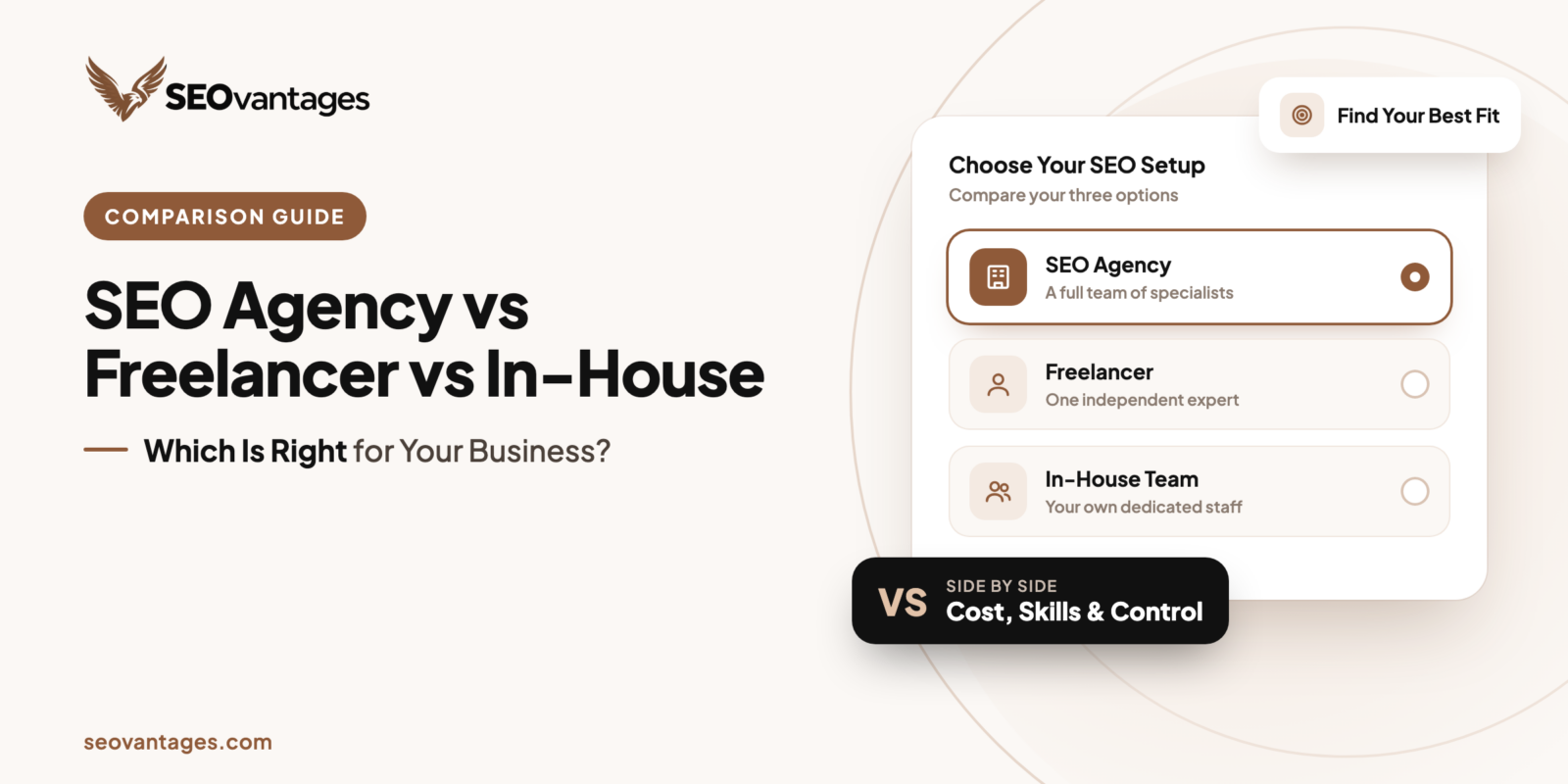
Choosing the right operational setup for organic search marketing is one of the most critical decisions a marketing leader makes. Businesses generally select among three core structures: an seo agency vs freelancer setup, or building an in-house seo team. Each path carries clear trade-offs in execution speed, breadth of expertise, direct control, and overall cost.
Understanding how these models compare helps you align your search strategy with your budget and internal resources.
Cost Comparison Table
Understanding the total cost of in-house seo team operations compared to third-party options requires looking beyond hourly rates or retainer fees. Direct salaries, overhead, tool stacks, and management overhead all impact your bottom line.
| Cost Element | In-House SEO Team | SEO Freelancer | SEO Agency |
|---|---|---|---|
| Direct Cash Cost | High (80,000–120,000+/yr base salary per specialist) | Low to Moderate (50–150/hr or 1,500–4,000/mo retainer) | Moderate to High (3,000–10,000+/mo monthly retainer) |
| Overhead & Benefits | High (20%–30% above base salary for healthcare, taxes, equipment) | None | None |
| Enterprise Tooling | High (500–2,000+/mo for Ahrefs, Semrush, Screaming Frog, etc.) | Included in their rate (basic stack) | Included in retainer (enterprise stack) |
| Management Time | High (requires internal oversight and management) | Moderate (requires clear briefs and oversight) | Low (account manager handles coordination) |
| Ramp-Up Overhead | High (30–90 days for recruiting and onboarding) | Low (1–2 weeks to start execution) | Low to Moderate (2–4 weeks for discovery and setup) |
Pros & Cons of Each Model
Every organizational structure has distinct advantages and operational drawbacks. Evaluating these factors prevents costly strategic mismatches down the road.
In-House SEO
Building an internal team gives you maximum alignment with your brand strategy.
Pros:
- Deep understanding of your business model, products, and industry context.
- Direct access and quick collaboration with internal web developers and content teams.
- Dedicated focus solely on your domain without competing client priorities.
Cons:
- High fixed annual expense regardless of performance or workload volume.
- Vulnerable to single-point-of-failure risks if the employee leaves.
- Limited exposure to broader cross-industry algorithm trends and test data.
SEO Freelancer
Working with an independent seo consultant vs agency provider offers maximum flexibility for specific projects.
Pros:
- Highly cost-effective for targeted tasks like a technical audit or specific content briefs.
- Direct line of communication with the specialist doing the actual work.
- Agility to pause or scale contracts with low commitment.
Cons:
- Individual capacity limitations create bottlenecks on large-scale rollouts.
- Skill sets are usually specialized in one area (e.g., content writing) rather than full-spectrum.
- Availability can fluctuate if they take on competing client projects.
SEO Agency
Partnering with an agency gives you access to a fully assembled team with multi-disciplinary talent when you choose to outsource seo.
Pros:
- Immediate access to a complete team: technical strategists, link builders, data analysts, and copywriters.
- Broad market intelligence derived from managing dozens of active accounts.
- Structured processes, accountability frameworks, and institutional continuity.
Cons:
- Higher monthly minimum investment compared to individual freelancers.
- Potential friction if communication relies heavily on account managers rather than direct executors.
- Requires careful vetting to avoid standard boilerplate strategies.
Skills Coverage (Technical, Content, Links)
Search engine optimization requires expertise across three major disciplines. A single practitioner rarely excels at all three equally:
- Technical SEO: JavaScript rendering, crawl budget optimization, Core Web Vitals, site architecture, and structured data implementation.
- Content Strategy: Intent mapping, keyword research, editorial planning, on-page optimization, and conversion rate optimization (CRO).
- Off-Page Authority: Digital PR, broken link building, content outreach, and brand mention acquisitions.
When you hire seo expert contractors individually, a freelancer who excels at link-building outreach may lack deep technical experience with headless CMS frameworks. Conversely, an in-house generalist may understand your product thoroughly but lack the outreach network required for aggressive authority building. Agencies typically distribute these distinct workloads across dedicated specialists in each discipline.
Scalability & Accountability
Scalability measures how quickly your search operations can adapt to expanding business needs, international markets, or sudden site migrations.
- In-House Teams: Scaling requires hiring additional full-time employees. This process introduces recruiting lead times, HR management, and ongoing payroll commitments.
- Freelancers: Scaling is constrained by the individual’s working hours. Expanding output often requires managing multiple individual contractors simultaneously, which increases administrative work.
- Agencies: Agencies scale by reallocating internal resources. If your site needs an immediate 50-page content expansion or an urgent technical audit, an agency can deploy additional specialists without changing contract structures.
Accountable reporting also varies by model. In-house hires are managed through standard quarterly KPIs and performance reviews. Freelancers are accountable for deliverables outlined in specific Statements of Work (SOW). Agencies operate under formal service level agreements (SLAs), monthly performance reporting, and clear business metrics tied to revenue and organic growth.
Hybrid Model
Many mature mid-market and enterprise organizations do not rely strictly on a single operational model. Instead, they implement a hybrid approach that combines internal domain knowledge with external resources.
A common hybrid structure pairs an internal SEO Manager with an external agency or specialist freelancers:
- Internal Lead: Handles stakeholder communication, product alignment, cross-departmental buy-in, and core strategy oversight.
- Agency Partner: Handles heavy technical auditing, large-scale content production, and ongoing link acquisition campaigns.
- Specialist Freelancer: Brought in for distinct one-off tasks, such as international translation, local schema integration, or specialized penalty recovery.
This setup balances internal alignment with external execution capacity, preventing in-house teams from becoming bogged down in execution tasks.
Decision Framework by Company Stage
To select the right structure, evaluate your current operational maturity, budget, and organic growth priorities.
Early-Stage / Bootstrapped Startups
- Primary Need: Cost efficiency and foundational technical setup.
- Best Fit: Freelancer or project-based consultant.
- Focus: Set up technical infrastructure, target low-competition long-tail search intent, and lay down clean site architecture without committing to high monthly retainers.
Mid-Market / Growth-Stage Companies
- Primary Need: Rapid traffic scaling, consistent content production, and authority acquisition.
- Best Fit: SEO Agency or a Hybrid Model.
- Focus: Outpace established competitors by leveraging multi-disciplinary agency teams to handle technical optimization, content creation, and digital PR concurrently.
Mature Enterprises
- Primary Need: Deep brand integration, cross-departmental coordination, and long-term search governance.
- Best Fit: In-House Team paired with specialized agency support.
- Focus: Maintain brand control, manage large-scale technical migrations, and utilize agencies to scale resource-intensive campaigns like link building and content expansions.
Frequently Asked Questions
Q: Is it cheaper to hire an in-house SEO?
No, hiring an in-house SEO specialist is rarely cheaper than working with a freelancer or entry-level agency retainer. Beyond the base salary (80,000–100,000+ per year), you must factor in employment taxes, healthcare benefits, onboarding costs, and premium software tools, which easily add thousands in monthly expenses.
Q: When should I outsource SEO?
You should outsource SEO when your internal team lacks specialized technical or link-building skills, when you need to scale content output quickly, or when hiring full-time staff is not financially practical. Outsourcing is also useful during site migrations, international expansions, or structural site overhauls that require immediate expert capacity.
Q: Can one SEO freelancer handle everything?
Usually no. Modern SEO covers technical development, content creation, digital PR, and data analytics. While a single freelancer can handle basic strategies and on-page tasks, they rarely possess deep expertise in all areas. Complex enterprise sites generally require a team with distinct specialist skills.
Q: What does an SEO agency do that a freelancer can’t?
An SEO agency provides a multidisciplinary team of technical engineers, content strategists, outreach experts, and data analysts under one contract. They also invest in enterprise-grade SEO toolsets, offer higher delivery capacity, and provide backup coverage to maintain project momentum even when individual team members change.
Practical Takeaways and Next Steps
Choosing between an agency, a freelancer, or an in-house team depends directly on your internal bandwidth, available budget, and growth timeline:
- Choose a Freelancer if you have a tight budget, need help with specific tasks, or want a one-off technical audit.
- Choose an In-House Specialist if you require full-time internal alignment, direct management, and close daily collaboration with your product team.
- Choose an Agency if you need a multi-disciplinary team capable of managing technical strategy, content creation, and link building simultaneously to accelerate revenue growth.
Evaluating your internal capacity and current site health is the best first step toward making the right operational choice.
At SEOvantages, we help businesses build and execute clear, revenue-driven search strategies. Whether you need complete SEO management or structured support for your internal team, our team delivers the technical, content, and link-building expertise required to grow organic search revenue. Contact SEO Vantages today for an objective evaluation of your current search performance and growth opportunities.