

Is SEO Worth It for Small Businesses? An ROI Breakdown With Real Numbers

According to research from BrightEdge, organic search drives 53% of all trackable website traffic across major industries. Yet, small business owners routinely hesitate to commit budget to search engine optimization due to its upfront costs and initial delay in organic returns. When managing tight cash flows, spending $1,500 to $5,000 per month without seeing instant revenue can feel like a gamble.
However, evaluating organic growth purely as an ongoing expense overlooks how acquisition channels function over time. Understanding whether is seo worth it for your specific company requires a direct analysis of lead costs, conversion benchmarks, and long-term customer value. Here is a practical, fact-based breakdown of how organic search performs against other channels, how to calculate your expected returns, and when you should avoid investing in search campaigns.
How to calculate SEO ROI
Measuring your seo return on investment requires looking past superficial metrics like keyword rankings or impression counts. True financial value depends on conversion tracking and customer lifetime value (CLV).
To establish an accurate seo roi calculation, gather these four primary data points from your analytics platforms:
- Total SEO Costs: The sum of agency retainer fees, in-house staff hours, software subscriptions, and content production costs over a specific timeframe.
- Organic Conversions: The total number of qualified leads or sales generated directly from organic search traffic.
- Average Conversion Rate: The percentage of website visitors from organic search who convert into paying customers.
- Customer Lifetime Value (CLV): The total gross revenue or profit a customer generates throughout their relationship with your business.
SEO vs paid ads cost per lead
Paid advertising channels like Google Ads or Meta Ads provide immediate visibility, but costs stop generating returns the moment a campaign pauses. In contrast, organic campaigns require heavy upfront investment before steadily reducing customer acquisition costs over time.
Data from FirstPageSage shows that while Pay-Per-Click (PPC) campaigns often deliver immediate initial lead volume, organic search systematically delivers lower long-term Cost Per Lead (CPL) across most B2B and consumer service verticals.
| Channel | Initial Time to Results | Cost Structure | Long-Term CPL Behavior |
|---|---|---|---|
| Paid Ads (PPC) | Immediate (1–7 days) | Pay per click / Pay per impression | Increases as ad platform competition grows |
| Organic SEO | Medium-term (4–9 months) | Fixed retainers / Fixed project fees | Decreases continuously as authority scales |
Why Cost Patterns Diverge
- PPC Dynamics: You pay every time a user clicks your link. If your average cost-per-click is $15 and your landing page converts at 5%, your raw cost per lead remains $300 regardless of how long the campaign runs.
- SEO Dynamics: An optimized landing page or resource guide costs a fixed amount to write, optimize, and rank. Once it reaches top search positions, it can attract thousands of qualified visits each month without additional marginal costs per click, rapidly reducing your overall CPL.
When SEO is NOT worth it
While organic visibility builds long-term equity, organic search optimization is not the right growth channel for every company. Investing under unsuitable operational conditions leads to depleted cash reserves and negative financial returns.
Investing in organic acquisition is generally not worth the money in the following scenarios:
- Short-Term Cash Requirements: If your company needs revenue within 30 to 60 days to survive, organic strategies will fail you. Ranking gains typically require 4 to 9 months depending on domain authority and market competition.
- Low-Search-Volume Products: If you offer an entirely novel product or custom service that consumers do not yet know to search for, organic search demand will be minimal. Demand generation channels (like paid social or outbound outreach) work better here than demand capture channels.
- Uncompetitive Conversion Infrastructure: Sending traffic to a slow, poorly designed website with broken forms or weak calls-to-action wastes capital. Organic rankings cannot overcome poor conversion rate optimization (CRO) or low service quality.
- Severe Budget Constraints: Attempting to execute an organic growth strategy on a $100-per-month budget leads to low-quality content, ineffective link acquisition, and eventual penalty risks from search engine algorithm updates.
Industries with the highest SEO ROI
The prospective return on investment from organic search varies significantly depending on profit margins, search demand, and client transaction sizes. Industries that feature high customer lifetime values or recurring contract revenue consistently see higher seo value.
Key High-ROI Industry Sectors
- Professional & Legal Services: Law firms, accounting agencies, and corporate consultancies operate with high client retainers. A single closed corporate law client acquired via search can cover an entire year’s optimization retainers.
- B2B Software & SaaS: High customer retention rates mean long-term enterprise contract values justify competitive target keywords and technical search campaigns.
- Home Services & Contracting: Homeowners facing emergency repairs (such as roofing, plumbing, or HVAC replacement) turn directly to local search queries. Converting high-intent commercial searches yields substantial immediate job margins.
- Specialized Healthcare & Dental: Medical practices offering high-ticket elective procedures (e.g., orthodontics, cosmetic surgery) capture long-term patient value from local organic rankings.
Compounding value of organic traffic
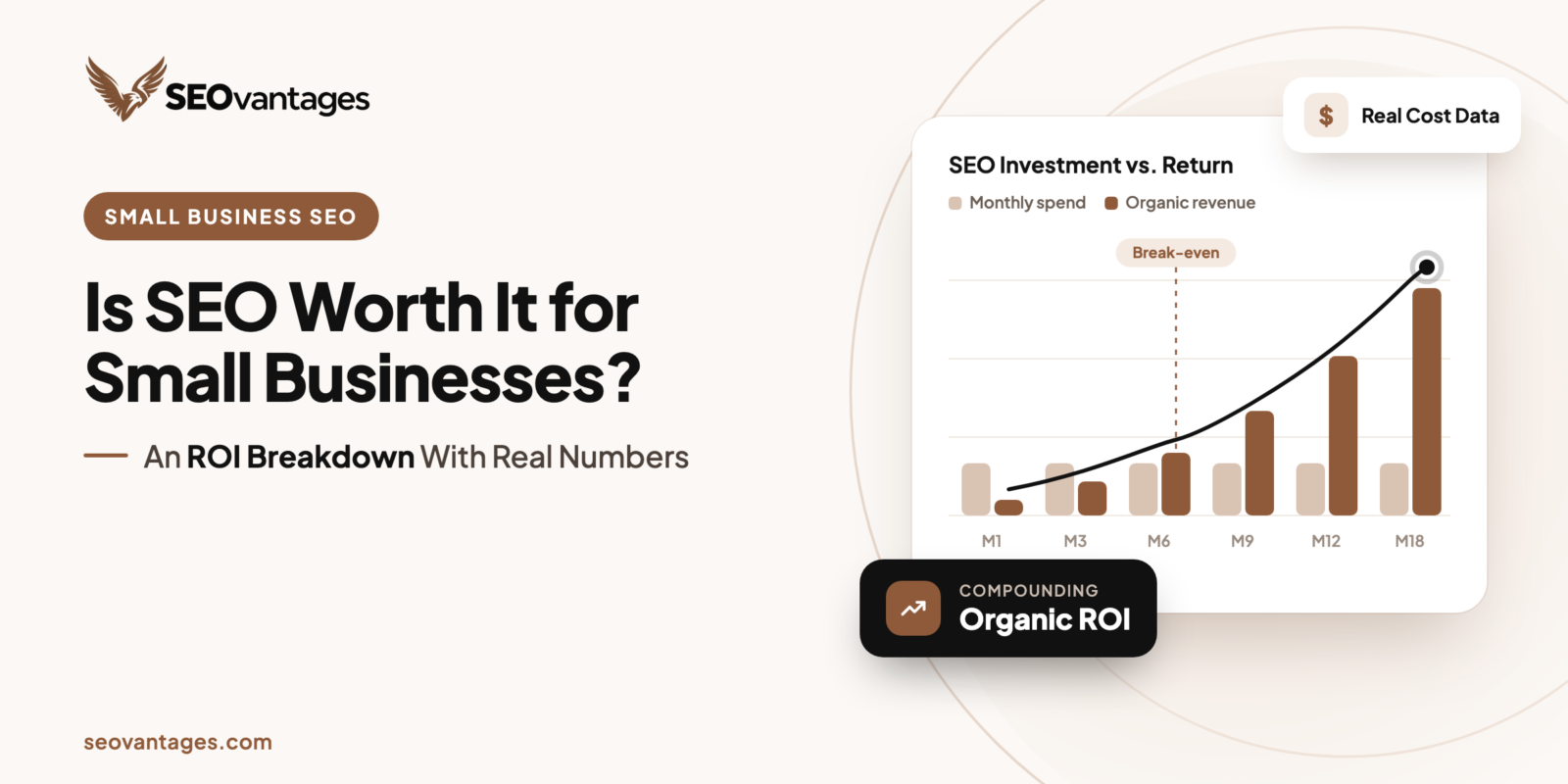
Unlike paid media, which functions like a utility tap, turning off the moment payments stop, organic optimization functions like an accrual investment account.
When you publish authoritative assets and fix core technical performance issues, those improvements remain active on your domain. Content created in Year 1 continues driving organic visits, generating leads, and supporting conversion paths into Year 2 and beyond without requiring equal recurring investments.
The Organic Competitive Moat
- Authority Accumulation: Earning backlinks and establishing topical coverage signals relevance to search algorithms, making subsequent content rank faster.
- Brand Equity: Consistently appearing at the top of commercial search results builds consumer trust before direct sales interactions begin.
- Decreasing Acquisition Costs: As domain authority scales, your cost-per-lead drops, freeing up capital to invest in secondary sales and marketing initiatives.
ROI calculator walkthrough
To project whether investing in an organic growth strategy makes financial sense for your business, run through this step-by-step projection exercise before committing capital.
Step 1: Identify Keyword Search Volume
Use tools like Google Keyword Planner to find the total monthly search volume for core commercial terms related to your service or product line within your geographic territory.
Step 2: Estimate Organic Click-Through Rates (CTR)
According to organic position CTR distribution studies from Backlinko:
- Position 1 captures approximately 27.6% of clicks.
- Position 2 captures approximately 15.8% of clicks.
- Position 3 captures approximately 11.0% of clicks.
Multiply your target keyword volume by an average target position CTR (e.g., 5% to 10% across page-one terms) to project realistic monthly organic traffic.
Step 3: Apply Your Conversion Rates
Calculate potential monthly conversions using your historical sales data:
Projected Monthly Leads=Projected Organic X Visits WebsiteConversionRate
Projected Monthly Sales=Projected Monthly Leads X Sales Lead-to-Close Rate
Step 4: Compare Projected Profit to Total Investment
Multiply your projected closed sales by average customer profit margins. Subtract your annual optimization fees (agency, software, content production) to determine whether the projected net margin justifies the campaign cost.
Frequently Asked Questions
Q: What is a good ROI for SEO?
A good ROI for organic search campaigns typically ranges between 3:1 (300%) and 5:1 (500%) net return over a 12-to-24-month horizon. High-margin industries like B2B software, legal services, and specialized healthcare often achieve significantly higher long-term ratios once domain authority matures.
Q: How do you measure SEO ROI?
Measure organic ROI by tracking total revenue generated from organic search conversions against total campaign expenditures. Use Google Analytics 4 event tracking to isolate organic leads, apply your team’s sales close rate and average customer lifetime value (CLV), and subtract total agency, team, and software costs using standard financial ROI formulas.
Q: Is SEO worth it in the age of AI search?
Yes, organic search remains highly relevant in an AI-driven search ecosystem. AI search overviews and generative search features pull information directly from authoritative, well-structured web sources. Maintaining strong organic search fundamentals ensures your business is cited and recommended within AI summaries and conventional search results.
Q: Should a startup invest in SEO?
Startups should invest in organic search if they have sufficient runway (at least 6 to 12 months) and operate in markets with existing search demand. However, early-stage startups needing immediate customer validation or short-term sales should prioritize direct outreach, performance ads, and direct networking before committing to long-term search campaigns.
Conclusion
Evaluating whether organic growth strategies are seo for small business success comes down to unit economics and timeline expectations. While organic channels require patient upfront capital, their ability to deliver compounding traffic and lowering costs per lead makes search optimization one of the most reliable long-term marketing channels available.
If your company operates in a sector with high customer lifetime value, established search intent, and reliable conversion systems, organic search provides a durable competitive advantage that paid ad channels cannot match over time.
Ready to see how organic strategy fits into your business model? Explore structured growth strategies with SEOvantages to analyze your search market, calculate direct performance projections, and build a predictable pipeline of qualified organic leads.